 Hewlett Packard Enterprise
Elevating HPE Partner & Agent Experience with AI-Powered Virtual Support Agent
Transformed a fragmented Quote-to-Cash support experience into a unified, AI-powered solution — eliminating long wait times and reducing friction across customers and agents.
The Virtual Support Agent reduced response times from ~24 hours to instant answers, improved agent efficiency by 2×, and drove 5× growth in self-service adoption, earning recognition as a TSIA Award finalist and Stevie® Bronze Award (AI-Powered Self-Service).
Context & Business Challenge
HPE's Quote-to-Cash process was fragmented across 5 different applications, creating significant friction for both partners and internal teams. The support experience was characterized by long response times, high drop-offs, and low satisfaction scores.
External Users (Partners, Distributors, Resellers)
Partners relied on multiple legacy systems just to retrieve basic information such as quote or order status. Even simple queries often took one business day to resolve, while competitors were delivering near-instant responses. Support entry points were scattered across 50+ applications with inconsistent labels and flows, leading to steep learning curves, repeated escalations, and frustration.
Internal Users (Sales, Care Agents)
Sales and Care teams depended on 4–6 different tools to piece together answers for partner queries. This fragmentation slowed resolution in high-volume environments and consumed agent capacity on repetitive questions that could have been resolved through self-service.
Business Goal: Establish a unified, omnichannel support experience that enables partners and internal teams to quickly access accurate information — reducing friction, accelerating resolution times, and improving productivity across the Quote-to-Cash lifecycle.
My Role & Leadership Scope
UX Manager
I defined the UX vision, scaled the design team, and led cross-functional execution to transform the Virtual Support Agent into a business-critical AI capability.
Vision & Executive Influence
Partnered with the VP of Digital Product to secure funding and long-term investment by clearly tying UX outcomes to business KPIs and operational efficiency.
Team Growth & Capability Building
Built and scaled a high-performing design team from 1 → 5, establishing clear ownership across research, product alignment, and scalable design execution.
User-Centric Strategy Shift
Reframed the product from a feature-driven chatbot to a problem-solving assistant by grounding decisions in user research, behavioral data, and real support scenarios.
Operational & Process Leadership
Embedded weekly cross-functional syncs and a centralized delivery tracker to improve transparency, speed decision-making, and align Product, Engineering, QA, and AI/ML teams.
Quality, Consistency & Continuous Improvement
Established usability, language, and interaction standards as the product scaled, while closely monitoring metrics and stakeholder feedback to guide iteration and improvement.
This role required balancing strategic direction, delivery execution, and organizational change, while operating at scale across multiple user groups and markets.
Key UX & Product Decisions
Problem-Solving Assistant vs. Feature-Centric Chatbot
We intentionally moved away from a traditional FAQ-based chatbot toward an intelligent, problem-solving assistant. Grounded in user research, this shift enabled natural language queries and contextual responses — reducing friction and making the experience feel closer to interacting with a human agent.
Self-Service First, Assisted Support When Needed
Designed a tiered support model that prioritizes automated self-service while enabling seamless escalation to Live Chat or Case creation. This approach balanced user autonomy with access to human support, significantly reducing unnecessary agent load without sacrificing experience quality.
Proactive Issue Resolution
Rather than waiting for users to ask for help, VSA proactively identified distressed orders and surfaced timely support options (Raise a Question / Live Chat). This prevented downstream issues and improved the overall purchase and support experience.
AI Transparency & Trust by Design
Applied GenAI to summarize problems and solutions for Care Agents, reducing analysis time while maintaining clarity, accuracy, and trust. Transparency in AI outputs was treated as a core UX requirement, not an afterthought.
Multi-Platform Availability
Deployed VSA consistently across Microsoft Teams, Slack, and embedded web experiences, ensuring users could access support in the flow of their work rather than forcing channel switching.
Global Readiness Through Dynamic Translation
Implemented language support across 12 languages, enabling partners worldwide to interact with agents in their preferred language and supporting scalable global adoption.
From MVP to Enterprise Support Platform (2023–2025)
The Virtual Support Agent evolved through three distinct stages, each expanding scope, capability, and organizational impact.
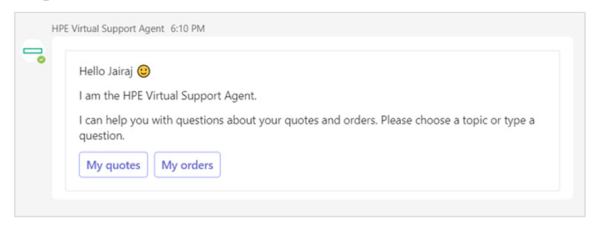
Stage 1 — 2023: MVP & Validation
Launched the initial Virtual Support Agent to validate core assumptions around self-service adoption and AI-assisted support. Focused on a narrow set of high-volume use cases (Quote/Order status) to establish proof of value, gather early user feedback, and secure executive confidence in continued investment.
Stage 2 — 2024: Expansion & Operational Integration
Extended VSA capabilities to support additional workflows, including proactive distressed order detection and Live Chat escalation. Integrated deeply with internal Care operations, enabling agent-side AI summarization and reducing resolution time. Scaled team from 1 to 5 designers and embedded cross-functional processes for faster iteration.
Stage 3 — 2025: Enterprise-Scale Omnichannel Support
Matured into a fully enterprise-grade AI support platform spanning Microsoft Teams, Slack, and embedded web experiences. Achieved 5× growth in self-service adoption, ~50% reduction in Order Management cases, and recognition as a 2025 TSIA Award finalist. The platform now serves as a strategic capability supporting HPE's broader digital transformation.
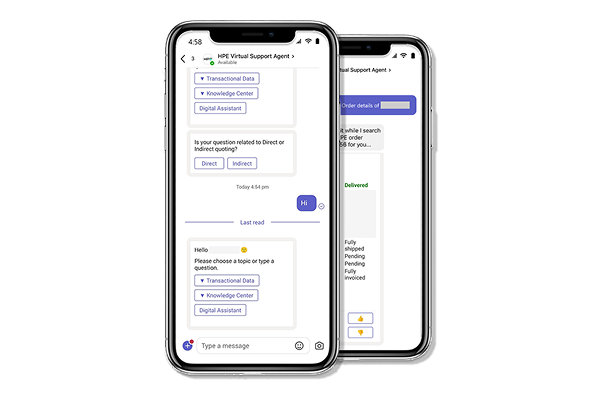
Seamless omnichannel availability across web, mobile, Teams, and Slack — meeting customers where they work.
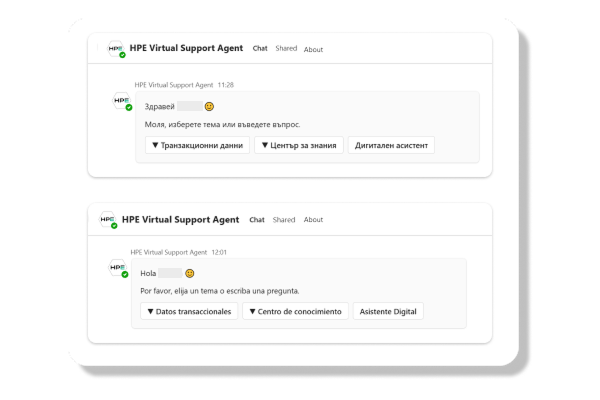
Multilingual AI support serving global enterprise customers with localized, context-aware responses.
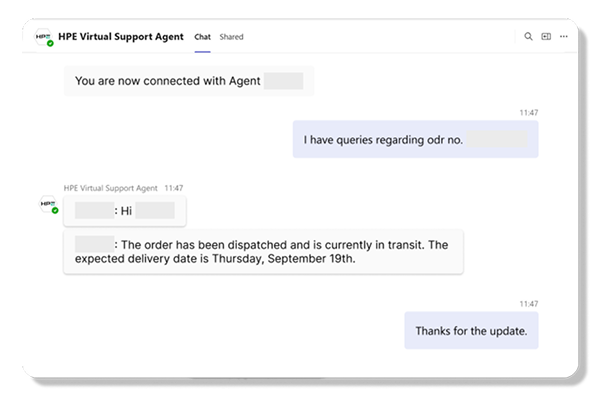
Intelligent escalation to live agents with full conversation context for seamless human + AI collaboration.
Outcomes & Measurable Impact
(Near-instant answers)
(~12 min → ~6 min per query)
(Growth in unique users)
(Order Management)
In less than three years, HPE’s Virtual Support Agent achieved 14× growth in message volume and a 5× increase in unique users, underscoring strong adoption and sustained value.
CSAT scores improved by 3–7 points, shifting from “Needs Improvement” to “Fair,” while significantly reducing dependency on traditional support channels.
Stakeholder Perspective
"HPE is far ahead of all other vendors with such tools like VSA, there is nothing comparable."
"I was able to use the tool and search for a GreenLake Opportunity. The UI is super slick and speed is so fast. This is AMAZING!"
"Possibly one of the greatest recent innovations helping us internally."
"I was struck by how quickly I got feedback on my query from the Live Agent in VSA, I was pleasantly surprised."
Leadership Takeaway
By aligning user needs with business priorities, we transformed support from a friction point into a competitive advantage — scaling both customer satisfaction and operational efficiency.
Scaling AI-powered UX at enterprise scale requires executive alignment, cross-functional collaboration, and continuous iteration grounded in real user behavior. The shift from a feature-centric chatbot to a problem-solving assistant was successful because every decision was anchored in user research and measurable business KPIs.
This work reinforced my belief that effective design leadership is not about shipping features — it’s about driving sustained, measurable business impact.